

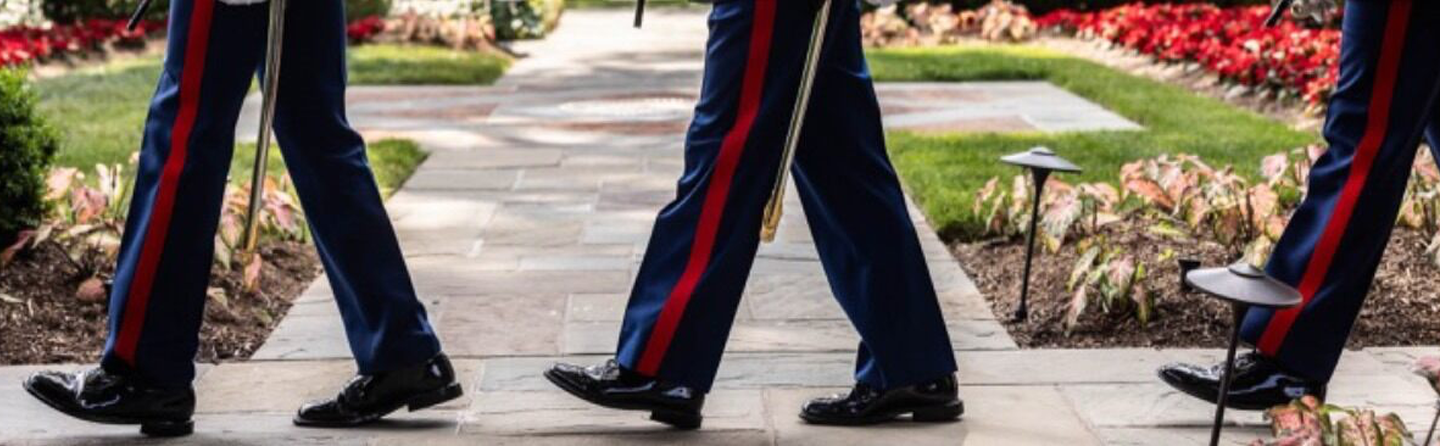
The Blood Stripe
A Legacy Sewn in Sacrifice
There’s a bold red stripe that runs down the outer seam of the Marine Corps dress blue trousers, a striking flash of color known simply as the “blood stripe.”
You may notice the detail of the stripe when Officers and NCOs wear their dress blues. But it’s not just a decoration on clothing. It’s both a reminder and a badge of honor stitched into the legacy of the Corps.

The year was 1847. The United States was at war with Mexico, and the Marines were called into action during the campaign to take Mexico City. The final, decisive assault came at Chapultepec—a fortress perched high above the city and thought nearly impossible to breach.
But impossible never stopped Marines.
On September 13, they stormed the steep slopes of Chapultepec Castle under withering fire. Cannon blasts shattered stone walls. Musket balls ripped through the air. Yet the Marines pressed forward, climbing the heights, scaling the walls, and finally taking the fortress in brutal, hand-to-hand combat.
Victory came at a terrible cost. The assault claimed the lives of many Marines, including nearly all the officers leading the charge. But their bravery and sacrifice shattered enemy resistance and opened the gates to Mexico City—a pivotal moment that helped end the war.

During the years that followed, a story began circulating that a red stripe was added to the dress blue trousers of Marine Officers and NCOs to represent the blood shed by those leaders who gave everything at the Battle of Chapultepec.
There's only one problem with the story. It's more fable than fact.
The blood stripe actually became part of the dress blue uniform used by the Marines several years before the battle occurred. Today, when you look at a group of Marines at formal events such as Marine Corps Balls, weddings, and official functions you will be able to determine the Marine Officers and NCOs by the blood stripe. But a truly close look can determine who is an officer and who is an NCO. That's because the specifications governing the stripe are actually very precise. It is one and a half inches wide on the uniform of NCOs and two inches wide on the uniform of officers, running the full length of the outer seam on both pant legs.
The symbolism of the blood stripe is no less precise. The scarlet fabric is a tribute to the sacrifice, leadership, and unshakable courage under fire demonstrated during every battle ever fought by the Marines, both before and after Chapultapec. It reminds us that leading Marines means being ready to give all, just as Marines have done since the Corps' founding in 1775.
For recruits dreaming of earning the uniform, the blood stripe offers a challenge and a promise. It says: When the moment comes, you will be ready. You will carry the legacy. You will lead.
Because, in the Marine Corps, every thread has meaning. And some of those threads are dyed in the blood of heroes.