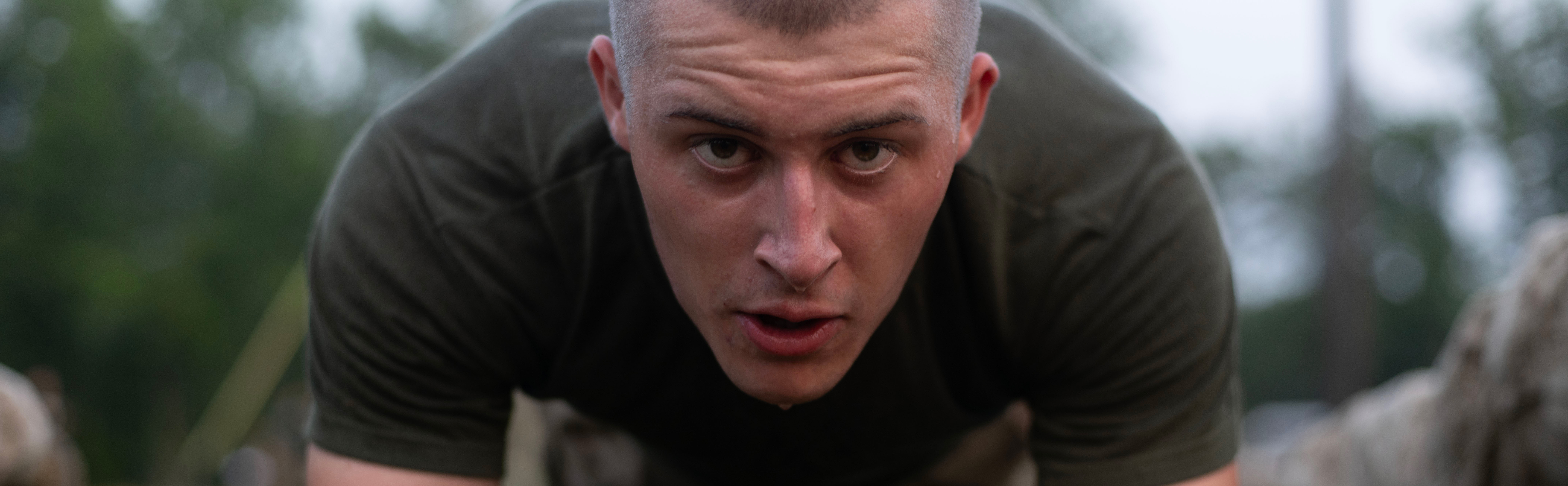
A Marine recruit with a shaved head completes a plank. He is looking straight into camera.

Hold the Line

The plank exercise during the IST and PFT

In the IST and PFT, time counts only when your form holds. Endurance, alignment, and discipline are crucial. That’s where the plank comes in.

If you are preparing for the Initial Strength Test (IST) or looking ahead to the Marine Corps Physical Fitness Test (PFT), understand this: every event exists for a reason.

The plank exercise exists to test control.

The plank measures core muscular endurance—your ability to maintain proper body alignment under sustained tension. Unlike explosive movements that rely on short bursts of power, the plank demands continuous muscular engagement over time. It exposes weaknesses quickly.

Many recruits underestimate it. And many are surprised by it.

Core strength matters in the Marine Corps because the core stabilizes nearly every movement you make. When you lift, carry loads, climb obstacles, run distance, or maintain posture under weight, your core is engaged. A strong core improves efficiency, protects the spine, and reduces risk of injury. Without it, performance suffers.

How is the plank conducted?

The plank is performed on the forearms with elbows directly beneath the shoulders. Forearms remain flat. Your body must form a straight line from shoulders to hips to heels.

Proper alignment requires:

  • Head neutral
  • Back flat
  • Hips neither sagging nor raised
  • Feet positioned shoulder-width apart

In the IST and PFT, time is counted only while you are in the proper position. If your alignment breaks, the clock stops. The standard is how long you can hold correct form, even through physical discomfort.

Common form breaks include hips rising or dropping, arching or rounding the back, shifting out of alignment, or removing a limb without authorization. If your form breaks, you will be corrected. Failure to immediately correct ends the event.

All this means attention to detail is crucial. Small alignment errors can have large consequences.

Physical and mental strength working together

It may sound easy to avoid these small alignment errors, but maintaining structural integrity becomes more difficult over time. That’s why mental strength plays a direct role in success during the plank.

As fatigue builds, your body signals you to stop or change your body position. Maintaining correct form requires discipline and the ability to push through the burning and discomfort.

So what can you do to succeed at the plank exercise? To begin with, focus on what you can control.

Prepare your body by practicing plank exercises and building strong core muscles. Prepare your mind by concentrating on alignment instead of watching the clock and maintaining composure as discomfort increases. Because discomfort is expected. But loss of focus is avoidable.

Practical tips to meet and exceed the standard

1. Train to the exact testing standard

Practice the forearm plank required for the IST and PFT. Variations do not replace specificity.

2. Build time gradually while protecting form

Increase hold times in controlled increments. Try 10-seconds at a time to begin. Then move up in 10-second increments from there. Remember: quality comes before duration.

3. Use controlled breathing

Slow, steady breaths reduce tension and help maintain stability under fatigue.

4. Correct form immediately in training

Do not allow poor alignment to become habit.

5. Stay engaged through the final second

Many lose time by relaxing early. Maintain discipline until the event is complete.

Inside the Marines

Go In-depth on the Corps

Explore additional articles on the training, traditions, and truths of the United States Marine Corps.

Discover More